
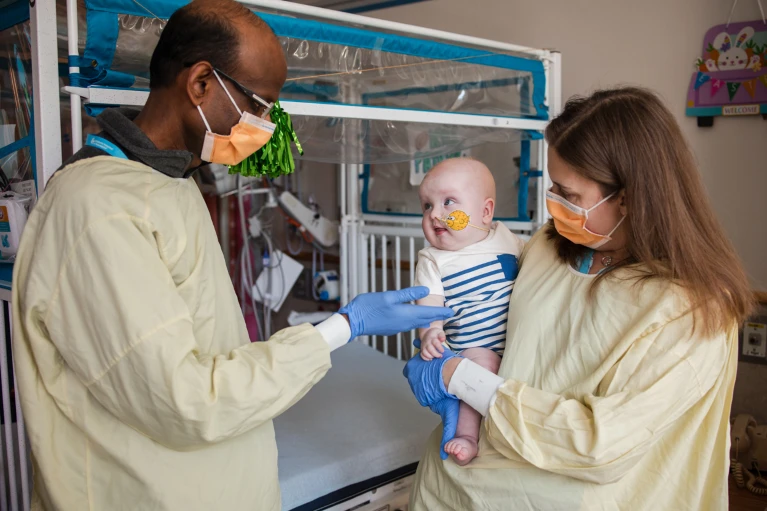
Image courtesy of the Children’s Hospital of Philadelphia.
Introduction: A New Era in Genetic Medicine
In a milestone that redefines the boundaries of modern medicine, a baby named KJ Muldoon has become the first known individual to receive a personalized CRISPR-based gene therapy designed specifically for his unique genetic mutation. Born with a rare and potentially fatal disorder that impaired his ability to metabolize protein, KJ is now showing signs of significant improvement after undergoing a groundbreaking, tailor-made treatment. This achievement, reported on May 15, 2025, in Nature by science journalist Heidi Ledford, has stirred both hope and debate across the medical community.
Citation: Ledford, H. “World’s first personalized CRISPR therapy given to baby with genetic disease.” Nature, 15 May 2025. doi: 10.1038/d41586-025-01496-z
The Diagnosis: A Life-Threatening Genetic Defect
KJ was born with a condition called carbamoyl phosphate synthetase 1 (CPS-1) deficiency. This genetic disorder stems from mutations inherited from both parents, which disrupt the production of an essential enzyme responsible for removing nitrogen from the body. The deficiency leads to dangerously high levels of ammonia in the blood, a situation that can cause brain damage or even death in infants.
Under normal circumstances, a liver transplant is considered the most effective treatment. However, this option was months away, and KJ’s condition was rapidly deteriorating. Only about half of babies with this severe form of CPS-1 deficiency survive long enough to receive a transplant.
The Breakthrough: Base Editing with CRISPR
KJ’s medical team at the Children’s Hospital of Philadelphia, led by pediatrician Dr. Rebecca Ahrens-Nicklas, decided to pursue an experimental therapy using a CRISPR-based method called base editing. Unlike conventional CRISPR techniques that cut DNA, base editing allows scientists to make precise, single-letter changes in the genetic code—ideal for fixing small but critical mutations like the one KJ carried.
Working against the clock, a coalition of academic researchers, clinicians, biotech companies, and U.S. federal regulators managed to design, test, and approve the personalized therapy in just six months—a timeline virtually unheard of in drug development. The process involved testing the therapy in mice and monkeys to ensure safety and efficacy before administering it to KJ.
The Treatment: Three Doses, Steady Progress
The treatment was administered in three rounds. After the first dose, KJ was able to tolerate the standard amount of dietary protein for his age, although he still needed medications to regulate his ammonia levels. A second dose further reduced his dependence on these medications. After a third and final dose, his doctors began to slowly taper off the medication, closely monitoring his response.
While the therapy is not yet a “cure,” early results are promising. KJ is hitting developmental milestones that once seemed impossible. As his mother Nicole recounted emotionally, she recently walked into his hospital room and found him sitting up by himself for the first time.
Challenges and Ethical Considerations
Despite this success, the therapy’s personalized nature raises questions about scalability and accessibility. Each treatment of this kind is customized to an individual’s genome, making it unlikely that it could be repurposed for other patients. Furthermore, the cost of developing bespoke gene therapies remains extremely high, even when scaled up for broader populations.
As Dr. Waseem Qasim from University College London noted, while the speed of development was “remarkable,” questions remain about how such therapies could be offered more broadly to other children with ultra-rare diseases.
Why This Matters: A Template for the Future?
This case sets a precedent. Although it is a “therapy-for-one,” it could serve as a model for treating other ultra-rare genetic disorders. It also opens the door to a future where personalized genetic medicine becomes more routine—particularly for diseases that are currently untreatable with conventional therapies.
Gene therapy expert Dr. Arkasubhra Ghosh, not involved in the study, remarked, “This truly is the future for all of these gene and cell therapies. It’s really exciting.”
Conclusion: A Milestone with Meaning
KJ Muldoon’s journey is both scientifically significant and emotionally powerful. It represents the convergence of cutting-edge science, regulatory agility, and human compassion. While personalized CRISPR therapies may not be scalable today, this case provides a hopeful glimpse into a future where medicine is as unique as our DNA.
As the world watches KJ grow, researchers continue to learn from him—about his biology, the therapy’s long-term effects, and how science might someday deliver similar hope to others.
References & Further Reading:
- Musunuru, K. et al. (2025). N. Engl. J. Med. https://doi.org/10.1056/NEJMoa2504747
- Ledford, H. (2025). Nature News Article. https://doi.org/10.1038/d41586-025-01496-z
Learn more at BioCareersHub.com
