
Launching a biotech startup is an exciting journey — you’re taking cutting-edge science and translating it into real-world impact. But after the initial excitement of brainstorming and lab work, one big question looms: how do you fund this journey?
In our previous post, “How to Start Your Biotech Startup in India”, we discussed how to identify a great biotech idea and take the first steps. This time, we’re moving one step further: understanding funding — especially at the crucial pre-seed stage. Think of this as building on the foundation you’ve laid. Funding in biotech is unique compared to other startups, given the need for labs, equipment, and regulatory steps. This guide breaks down the Indian funding landscape while also learning from global biotech hubs.
The Biotech Funding Journey: From Pre-Seed to Series A
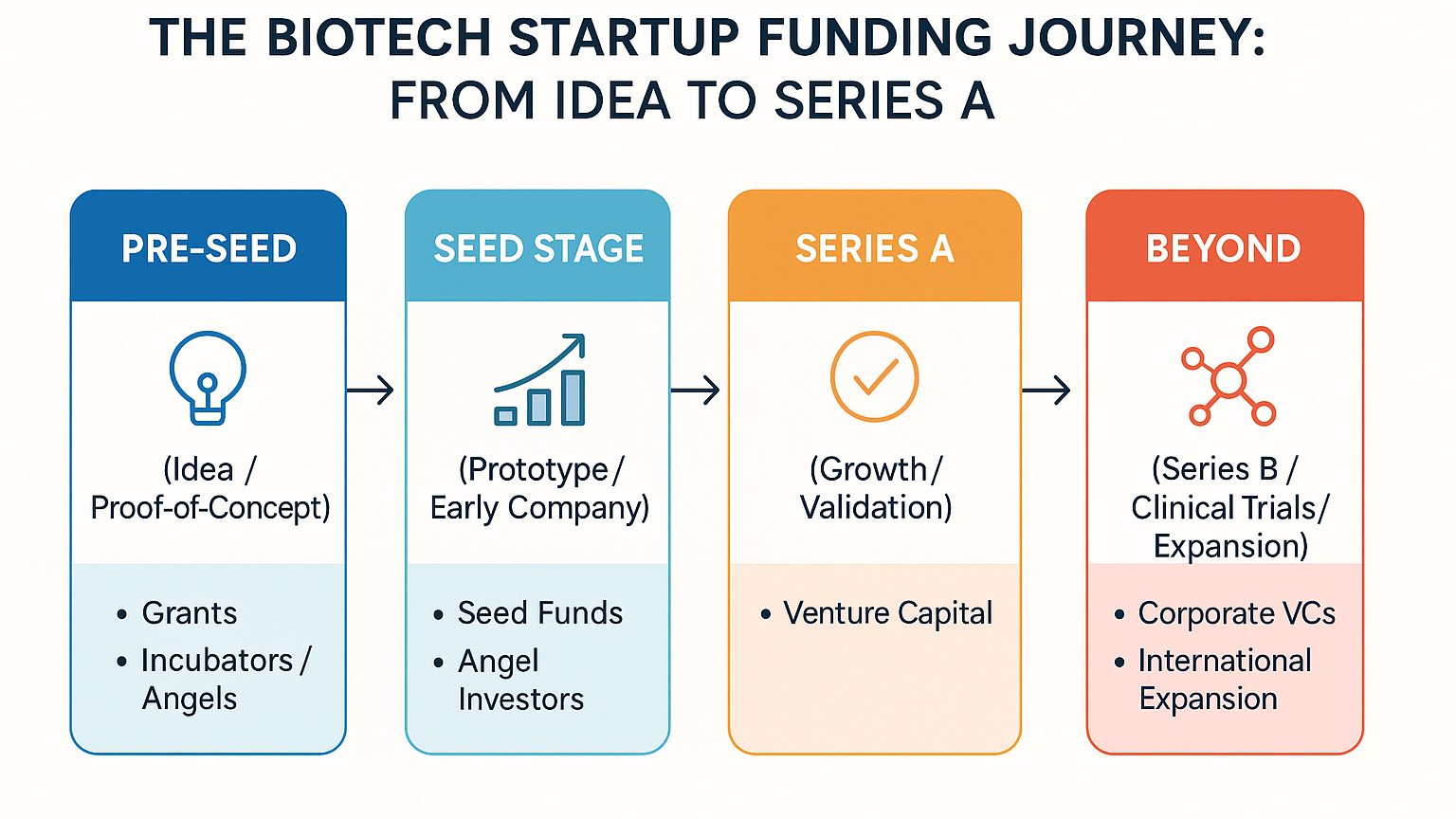
Every startup’s path is unique, but most biotech companies move through several key funding stages:
Pre-Seed (Ideation/Proof-of-Concept): This is where your scientific idea starts to take shape — maybe you have some preliminary data or a lab prototype. Funding at this stage often comes from personal savings, government grants, or support from incubators. Private investors are usually cautious at this stage, but in biotech, grants are a major lifeline.
Seed Stage: Once you have proof-of-concept, you might incorporate a company and build an early prototype or pre-clinical research. Funding here can come from angel investors, seed venture funds, or additional grants. Investors look for validation of the science and a clear potential application. In India, seed rounds often range from ₹1–5 crore.
Series A and Beyond: At this stage, your startup is showing real promise — perhaps a lead drug candidate, validated technology, or paying customers. Larger venture capital funds come in to support expansion, advanced trials, team growth, and global expansion. Series A rounds can be significant, and international investors or corporate partners often join in.
At pre-seed, you’re convincing funders that your idea is worth a shot. Each stage after that is about reaching bigger milestones that increase the value of your startup.
Learning from Global Biotech Funding Hubs
Before focusing on India, it’s helpful to learn from other countries with strong biotech ecosystems:
- United States: Biotech startups often grow out of universities with support from federal grants and accelerators like IndieBio. Early-stage VCs and corporate investors are also active here, but competition is fierce.
- Europe: Countries like the UK, Germany, Switzerland, and France have strong government-backed grant programs and incubators. Funding is often more risk-averse but still supports strong science.
- East Asia: Japan, China, and Singapore have growing biotech sectors. Governments and corporate investors support R&D, and global accelerators are increasingly active here too.
Indian founders can learn from these hubs that early-stage grants and incubators are crucial, and that international networks can open doors to global opportunities. Biotech is a long game everywhere — patience and a solid plan are key.
The Indian Biotech Funding Ecosystem (Pre-Seed Focus)
India’s biotech ecosystem has matured significantly. At the pre-seed and seed stages, your main funding pillars are government grants, incubators/accelerators, and angel investors.
Government Grants
- BIRAC Biotechnology Ignition Grant (BIG): A flagship grant of up to ₹50 lakh for proof-of-concept work. It covers R&D, hiring, and outsourced studies. Applications open twice a year and are highly competitive.
- Other BIRAC Schemes: Programs like SBIRI and BIPP support advanced development. Additional grants target specific challenges in vaccines, devices, and sanitation.
- DST NIDHI PRAYAS and Seed Support: For prototyping and early development, even beyond biotech. State-level schemes also exist, adding more avenues.
Grants help you build critical early-stage data without giving up equity.

Biotech Incubators and Accelerators
- BIRAC BioNEST Incubators: Over 50 across India, offering lab space, mentorship, and networking. Many are BIG grant partners.
- Other Accelerators and Corporate Programs: While fewer than in tech, programs by Social Alpha and pharma companies can help. Even global accelerators sometimes support Indian startups with global relevance.
Angel Investors and Early-Stage VCs
- Angel Networks: Groups like Indian Angel Network and BioAngels (by BIRAC) invest small amounts (₹25 lakh to ₹2 crore) and provide mentorship.
- Early-Stage VCs: Funds like Bharat Innovation Fund, Ankur Capital, and others support science and deep-tech ventures, often at seed or pre-Series A.
International funds like CARB-X or Y Combinator have also supported Indian biotech startups addressing global challenges.
What Funders Look for at Pre-Seed Stage
Whether you’re applying for a grant or pitching to an investor, funders look for:
- A clear problem and market need. How does your solution address an unmet need?
- Scientific innovation. What makes your approach unique or better than existing solutions?
- A capable team. Do you have the expertise to execute? Gaps can be filled with advisors or mentors.
- A proof-of-concept plan. Funders want to see milestones and a clear roadmap.
- Commercial and regulatory awareness. Show that you understand the path to market.
- Use of funds. Explain how the money will advance your project and what milestones it will achieve.
How to Prepare for Fundraising
- Refine your pitch. Make it clear and compelling for both technical and non-technical audiences.
- Prototype and early data. Even small results show your ability to execute.
- Protect your IP. A provisional patent helps build credibility.
- Plan your funding mix. Use a combination of grants and small equity investments to extend your runway.
- Leverage incubators and networks. They offer labs, mentorship, and investor connections.
- Plan for regulatory and manufacturing. Understand approval processes and potential production challenges.
- Stay persistent. Fundraising can be tough — every rejection is a chance to improve.
Real-Life Success Stories
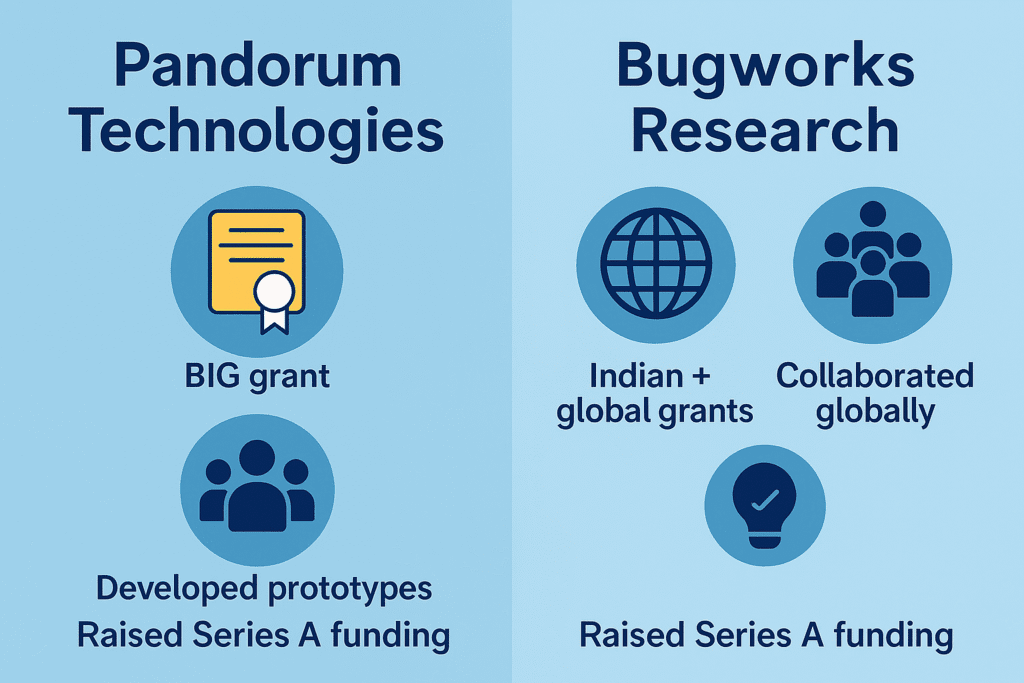
- Pandorum Technologies: Started with BIG and SBIRI grants, developed prototypes at C-CAMP, then raised Series A funding. They balanced grants and VC money to build a strong team and technology pipeline.
- Bugworks Research: Combined Indian grants with global funding from CARB-X, then raised Series A funding. Their collaborative approach and global relevance opened doors to international investors.
These examples prove that perseverance, strategic use of grants, and global networking can help you succeed in India’s biotech landscape.
Closing Thoughts
Funding a biotech startup is complex but achievable. Use this guide — and our previous post on finding a great idea — as a roadmap. Remember, funding isn’t the goal — it’s the fuel that powers your mission to make an impact in health, agriculture, or the environment.
In our next post, we’ll dive deeper into scaling up: entering the seed and Series A phases, team expansion, and strategies for sustainable growth. Stay tuned to BioCareersHub for that.
Join our Facebook and Instagram communities to share experiences, ask questions, and learn from fellow biotech founders. Remember, you’re not alone — an entire ecosystem is ready to help you succeed.
Resources
- BIRAC: birac.nic.in
- BIG Grant: birac.nic.in/desc_new.php?id=262
- BIRAC BioNEST: birac.nic.in/bionest.php
- DBT India: dbtindia.gov.in
- Startup India: startupindia.gov.in
- Venture Center Pune: venturecenter.co.in
- C-CAMP Bangalore: ccamp.res.in
- IKP Knowledge Park Hyderabad: ikpknowledgepark.com