
Artificial Intelligence (AI) is transforming every corner of science, and biology is no exception. Once seen as a purely laboratory-based field, biology has now become a data-intensive science. Sequencing genomes, analyzing proteins, studying cells, and even monitoring ecosystems generate massive amounts of information every day. AI, with its ability to recognize patterns and make predictions, has become one of the most powerful tools for making sense of this complexity.
For students in biology, learning about AI is not only about keeping up with a trend; it is about preparing to be part of the next wave of discoveries. This article introduces AI in biology in a clear, step-by-step manner—starting from definitions, moving through applications, and ending with practical advice for students who wish to engage with this growing field.
1. Understanding AI, ML, and DL: The Hierarchy
One of the most common sources of confusion is the relationship between Artificial Intelligence (AI), Machine Learning (ML), and Deep Learning (DL). They are often used interchangeably, but in reality, they describe different levels of specificity.
- Artificial Intelligence (AI): The broadest concept. AI refers to the design of machines or computer systems capable of performing tasks that would normally require human intelligence. This includes decision-making, problem-solving, language understanding, and pattern recognition.
- Machine Learning (ML): A subset of AI. Instead of explicitly programming rules, ML uses algorithms that “learn” from data. With each new dataset, the system refines its predictions. In biology, ML can cluster gene expression profiles, predict protein–ligand binding affinities, or classify cell types.
- Deep Learning (DL): A further subset of ML. DL relies on artificial neural networks with multiple layers, capable of handling extremely complex patterns and very large datasets. DL excels in image analysis, speech recognition, and natural language processing. In biology, DL has powered advances such as AlphaFold for protein structure prediction and automated interpretation of medical imaging data.
Think of the relationship as a set of nested circles:
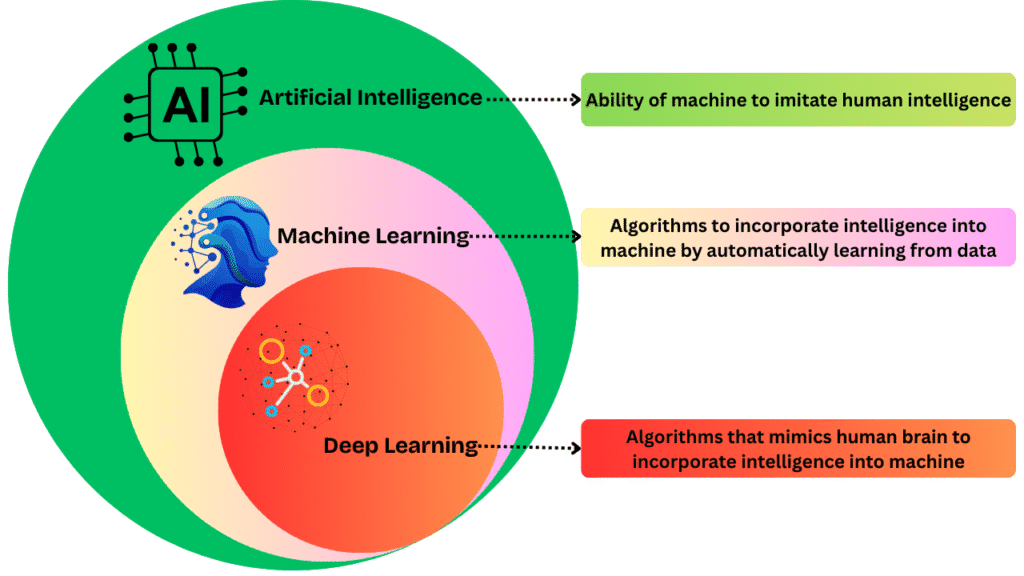
Understanding this hierarchy is critical because many of the exciting applications in biology are specifically powered by ML and DL, even though they are popularly described under the umbrella of AI.
2. Why Biology Needs AI
Biology today faces a paradox. We are capable of collecting more data than ever before, but interpreting it meaningfully is harder than ever. Consider:
- The human genome alone contains over 3 billion base pairs. Sequencing technologies can now produce this data for thousands of individuals in a short time.
- A cell contains thousands of proteins that interact dynamically. Studying these interactions generates terabytes of molecular data.
- Hospitals worldwide generate enormous volumes of clinical, imaging, and patient data every single day.
Traditional methods of analysis are not equipped to handle this scale and complexity. This is where AI steps in. It does not replace the human biologist, but it extends human capacity to detect patterns, generate hypotheses, and make predictions that would otherwise take decades.
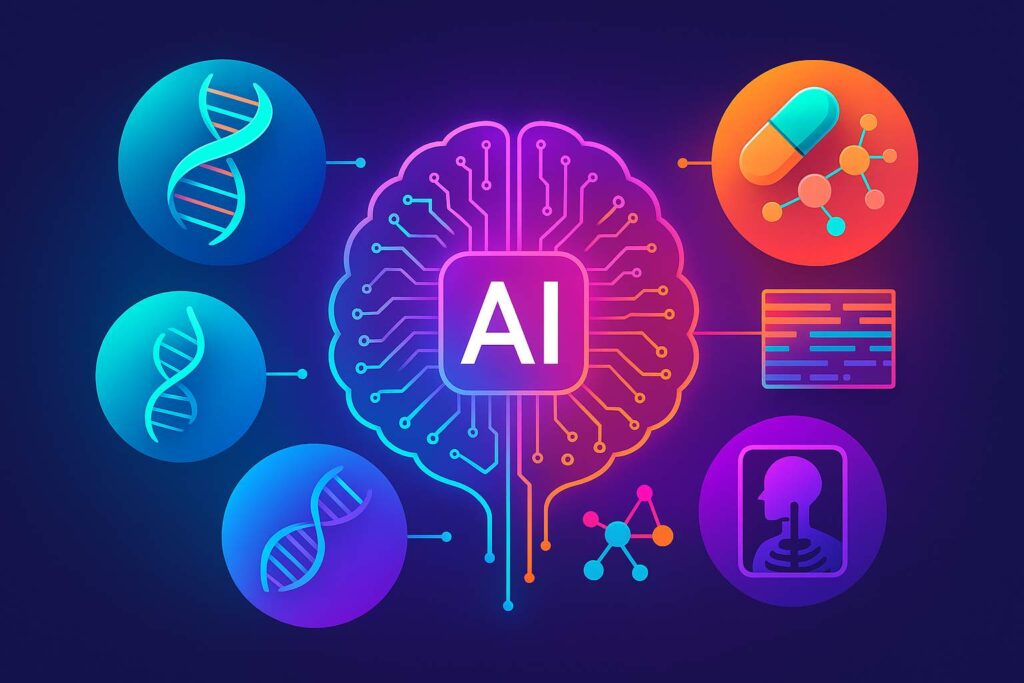
For example:
- In genomics, AI can detect subtle variations in DNA that are linked to disease risk.
- In drug discovery, AI models can screen millions of chemical compounds to identify potential therapeutic molecules within weeks.
- In clinical research, AI tools can predict patient outcomes, recommend treatments, and even spot early signs of disease from medical images.
3. A Short History: AI’s Entry into Biology
The application of computers to biology is not new. In the 1990s, the rise of bioinformatics gave us tools like BLAST for comparing DNA and protein sequences. However, these were rule-based methods rather than adaptive systems.
The major shift came in the 2010s with the success of machine learning and deep learning. As computing power increased and datasets grew, biology adopted these methods quickly:
- 2018–2020: DeepMind’s AlphaFold solved the long-standing problem of protein structure prediction, achieving accuracies previously thought impossible.
- 2020–2021: During the COVID-19 pandemic, AI systems analyzed viral genomes, suggested potential drug targets, and accelerated vaccine development.
- 2022 onwards: Generative models began designing novel proteins and small molecules, while integrative AI systems combined genomic, proteomic, and clinical data to build holistic disease models.
This history shows how AI evolved from a supportive tool to a central driver of modern biology.
4. Applications of AI in Biology
The strength of AI lies in its versatility. Let us explore some of the areas where AI is already reshaping biology:
a) Protein Structure and Function
Predicting protein folding was once one of the grand challenges of biology. AlphaFold’s success demonstrated the ability of deep learning to capture the physical principles underlying protein structures. Today, researchers can access predicted structures for millions of proteins, saving years of experimental work.
b) Drug Discovery and Development
AI accelerates nearly every stage of drug discovery:
- Screening chemical libraries to identify hits.
- Predicting binding affinities and ADMET (absorption, distribution, metabolism, excretion, and toxicity) profiles.
- Designing completely new molecules through generative models.
Insilico Medicine, for example, used AI to design a novel drug candidate that entered clinical trials in record time.
c) Genomics and Precision Medicine
AI tools are used to analyze sequencing data to identify disease-associated mutations, predict patient-specific responses to drugs, and guide precision oncology therapies.
d) Medical Imaging and Diagnostics
AI systems trained on radiology or pathology slides can detect cancers, brain abnormalities, or retinal diseases at accuracies comparable to experts. This reduces diagnostic errors and supports doctors in decision-making.
e) Systems Biology and Multi-Omics
Complex diseases such as cancer or Alzheimer’s involve multiple molecular layers. AI enables integration of genomics, proteomics, metabolomics, and transcriptomics, producing a more complete understanding of biological systems.
5. Why Students Should Care
For students in biology, the integration of AI is not a passing trend; it is a fundamental shift. Here are three reasons to take it seriously:
- Interdisciplinary Edge: Future biology will not be purely experimental or purely computational—it will be both. Biologists who can navigate both domains will be essential.
- Career Opportunities: Pharmaceutical companies, biotech startups, and academic labs are actively hiring people with biology and AI skills. Roles in bioinformatics, computational biology, and AI-driven research are rapidly expanding.
- Empowerment in Research: Students with AI skills can analyze data independently, test hypotheses computationally, and accelerate discovery without always waiting for experimental results.
6. How to Begin: A Student’s Roadmap
The first steps into AI do not require becoming a full computer scientist. Instead, biology students can follow a gradual approach:
- Learn the Basics of Programming: Start with Python. Libraries like Biopython, NumPy, and Pandas are widely used in computational biology.
- Understand Data: Focus on how biological datasets are structured—FASTA for sequences, PDB for proteins, VCF for variants, etc.
- Practice with Public Datasets: Explore resources like the Protein Data Bank (PDB), ChEMBL (chemistry), and TCGA (cancer genomics).
- Take Beginner Courses: Online platforms such as Coursera and edX offer biology-focused AI courses.
- Build Confidence with Simple Projects: For example, try predicting whether a small molecule is drug-like using a machine learning classifier, or analyze gene expression datasets for clustering.
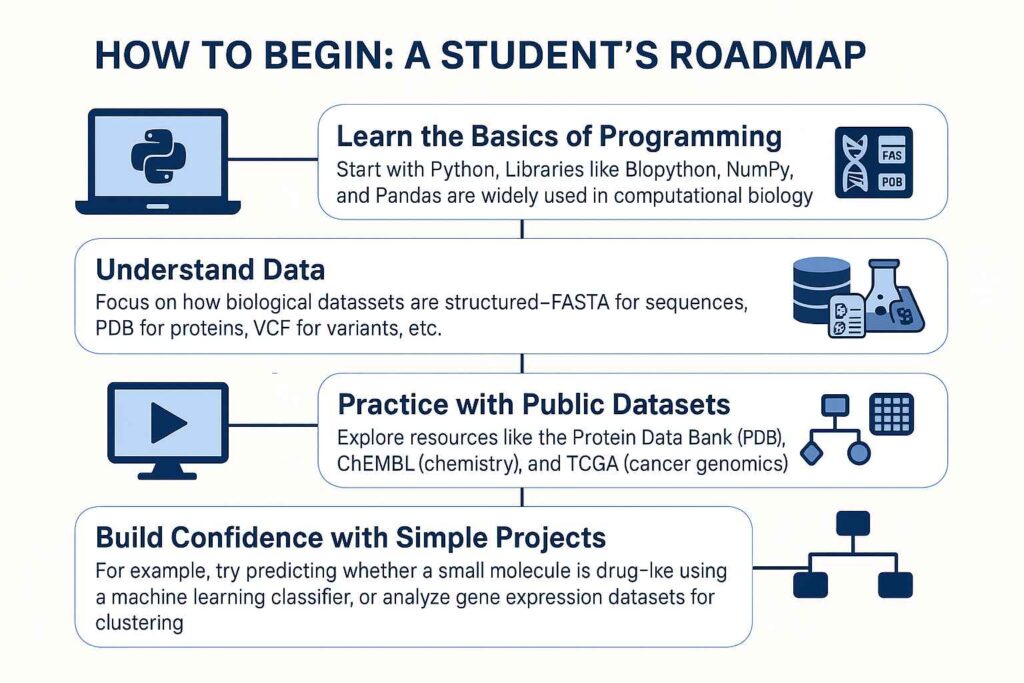
By layering skills gradually, students can bridge their biology background with computational literacy.
7. Looking Ahead
The future of AI in biology is rich with possibilities:
- Generative AI: Designing not only new molecules, but also entirely new proteins or biological circuits.
- Explainable AI (XAI): Developing transparent models that biologists can trust and interpret.
- Federated Learning: Allowing hospitals to train models on private patient data without violating confidentiality.
- AI-Driven Laboratories: Automating experiment design, execution, and analysis, accelerating discovery cycles.
Students entering this field today are not merely learners—they are the future architects of biology.
Conclusion
AI is not a replacement for biologists but a transformative extension of their capabilities. From protein folding to patient care, AI offers tools to interpret complexity at scales never before possible. For students, understanding the fundamentals of AI, ML, and DL is the first step toward contributing to this new era of biology. The journey may seem daunting, but resources are accessible, and the potential rewards—for science, medicine, and society—are immense.
References and Resources
- Jumper, J., Evans, R., Pritzel, A., et al. (2021). Highly accurate protein structure prediction with AlphaFold. Nature, 596, 583–589.
- Zhavoronkov, A., Ivanenkov, Y. A., et al. (2019). Deep learning enables rapid identification of potent DDR1 kinase inhibitors. Nature Biotechnology, 37(9), 1038–1040.
- Esteva, A., Kuprel, B., et al. (2017). Dermatologist-level classification of skin cancer with deep neural networks. Nature, 542, 115–118.
- The Cancer Genome Atlas (TCGA): link
- ChEMBL Database: link
- Protein Data Bank (PDB): link
For more insights on AI in Biology, career opportunities, and research trends, stay connected with BioCareersHub – your guide to the future of life sciences