
The Joint CSIR-UGC NET is one of the most significant examinations in India for students who aspire to build a career in scientific research and higher education. Conducted by the National Testing Agency (NTA), this exam determines the eligibility of Indian nationals for the award of Junior Research Fellowship (JRF), appointment as Assistant Professor, and admission to Ph.D. programs in universities, IITs, and national laboratories across the country.
This article provides a detailed overview of the CSIR-UGC NET December 2025 examination, including its importance, eligibility requirements, benefits of qualifying, exam structure, syllabus details, key dates, the application process, preparation strategies, and common mistakes to avoid.
Importance of the CSIR-UGC NET
The CSIR-UGC NET is more than just an eligibility test. It plays a vital role in shaping the career of science graduates and postgraduates. Students who qualify gain access to opportunities that include research fellowships, academic appointments, and advanced doctoral studies.
The Junior Research Fellowship is highly prestigious, offering not only financial support but also recognition as a researcher of merit. Universities, colleges, and national laboratories consider CSIR-UGC NET qualification as a benchmark of academic excellence. In addition to academic positions, several public sector undertakings (PSUs) and R&D organizations take NET scores into account during their recruitment processes. Thus, clearing the exam establishes credibility, provides financial support, and enhances career prospects in research, teaching, and industry.
Eligibility Criteria
The eligibility requirements are designed to ensure that only candidates with strong academic backgrounds apply.
- General and EWS category candidates must have at least 55 percent marks in their Master’s degree or equivalent.
- Candidates belonging to OBC-NCL, SC, ST, PwD, and Third Gender categories require at least 50 percent marks.
- Students in the final year of their Master’s degree or awaiting results are also eligible to apply provisionally. They must complete the degree within one to two years of the result declaration.
- Ph.D. holders who completed their Master’s degree before September 1991 are given a relaxation of 5 percent in marks.
- Candidates with a four-year Bachelor’s degree program must have at least 75 percent marks to be eligible for JRF and Ph.D. admission. However, they will not be eligible for Assistant Professor.
These conditions ensure that candidates entering into fellowship or academic pathways have a strong academic foundation.
Age Limit
The upper age limit depends on the category of eligibility:
- For Junior Research Fellowship (JRF), the maximum age is 30 years as of December 2025. Relaxation of up to 5 years is available for OBC-NCL, SC, ST, PwD, Third Gender, women candidates, and those with research or armed forces experience.
- For Assistant Professor positions, there is no upper age limit.
- For Ph.D. admission through CSIR-UGC NET, there is also no upper age limit.
This flexibility makes the exam accessible to a wide range of candidates, particularly those aiming for teaching and research careers later in life.
Benefits of Qualifying
Qualifying for the CSIR-UGC NET provides several advantages:
- A JRF fellowship offers a monthly stipend of 37,000 rupees for the first two years, which is upgraded to 42,000 rupees from the third year onwards upon successful progress assessment.
- Candidates qualifying for Assistant Professor can apply for faculty positions in universities and colleges across India.
- The exam serves as an entrance test for Ph.D. programs, giving candidates a smoother path into doctoral research.
- Special fellowships supported by the Ministry of Earth Sciences are also available for selected candidates in Earth Science fields.
- In addition to academic benefits, the qualification enhances employability in PSUs, biotechnology firms, and private R&D organizations.
About the Examination
The CSIR-UGC NET December 2025 will be conducted in a computer-based mode. The exam will consist of objective-type multiple-choice questions, divided into three parts:
- Part A: General Aptitude, including reasoning ability, numerical skills, puzzles, and graphical analysis.
- Part B: Subject-specific questions covering conventional topics from the chosen discipline.
- Part C: Higher-order analytical questions requiring application of scientific concepts.
The exam duration is three hours, and the paper is available in both English and Hindi.
Subjects Covered in CSIR-UGC NET December 2025
The examination is offered in five major disciplines of science. Each subject has a defined structure and marking scheme.
1. Chemical Sciences (Code 701)
- Total Questions: 120
- Maximum to Attempt: 75
- Marking: Part A (2 marks), Part B (2 marks), Part C (4 marks)
- Negative Marking: 25% in all sections
- Focus areas include organic chemistry, inorganic chemistry, physical chemistry, and interdisciplinary topics.
2. Earth, Atmospheric, Ocean, and Planetary Sciences (Code 702)
- Total Questions: 150
- Maximum to Attempt: 75
- Marking: Part A (2 marks), Part B (2 marks), Part C (4 marks)
- Negative Marking: 25% in Part A and B, 33% in Part C
- Covers geology, atmospheric science, oceanography, planetary science, and applied earth sciences.
3. Life Sciences (Code 703)
- Total Questions: 145
- Maximum to Attempt: 75
- Marking: Part A (2 marks), Part B (2 marks), Part C (4 marks)
- Negative Marking: 25% in all sections
- Includes molecular biology, genetics, physiology, ecology, immunology, evolution, biotechnology, and applied biosciences.
4. Mathematical Sciences (Code 704)
- Total Questions: 120
- Maximum to Attempt: 60
- Marking: Part A (2 marks), Part B (3 marks), Part C (4.75 marks)
- Negative Marking: 25% in Part A and B; no negative marking in Part C
- Focuses on linear algebra, real and complex analysis, differential equations, probability, numerical methods, and other advanced areas.
5. Physical Sciences (Code 705)
- Total Questions: 75
- Maximum to Attempt: 55
- Marking: Part A (2 marks), Part B (3.5 marks), Part C (5 marks)
- Negative Marking: 25% in all sections
- Topics include classical mechanics, electromagnetism, quantum mechanics, thermodynamics, statistical physics, and condensed matter physics.
This subject-specific structure ensures that candidates are tested fairly in their own discipline while also assessing their general scientific aptitude.
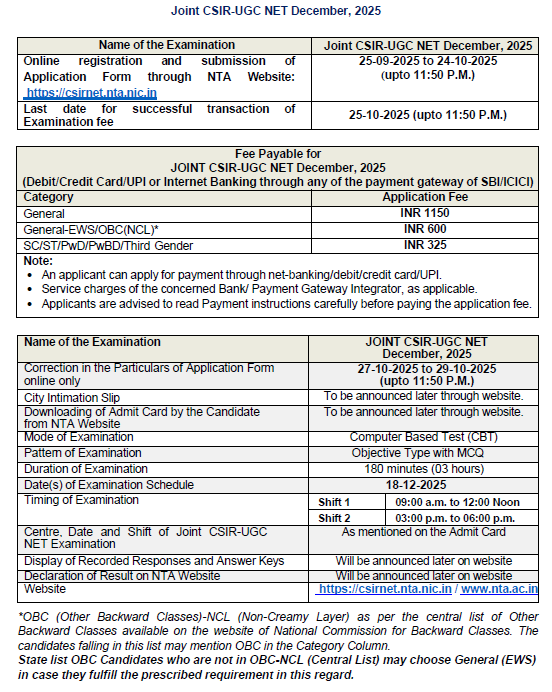
Key Dates for December 2025
- Online registration opens: 25 September 2025
- Last date to apply: 24 October 2025 (up to 11:50 PM)
- Last date for fee payment: 25 October 2025
- Correction window: 27 to 29 October 2025
- Admit card release: To be announced later
- Exam date: 18 December 2025
- Result declaration: To be announced later
Candidates must keep track of these dates and ensure they complete their applications well before the deadlines.
Application Process
The entire application process is online through the official website https://csirnet.nta.nic.in. Candidates must register, fill out the application form, upload scanned documents such as photographs and certificates, and pay the application fee online.
The fee structure for December 2025 is as follows:
- General: 1150 rupees
- OBC (NCL)/EWS: 600 rupees
- SC/ST/PwD/Third Gender: 325 rupees
Only one application per candidate is accepted, and multiple forms will lead to rejection. Candidates should ensure that all details are accurate and that they retain a copy of the confirmation page for future reference.
Preparation Tips
Preparation for CSIR-UGC NET requires a focused and consistent approach. Candidates should begin by carefully going through the syllabus provided by CSIR-HRDG. They should create a timetable that balances subject-specific study with aptitude practice.
Studying standard textbooks, referring to authentic notes, and solving previous years’ question papers are essential steps. Mock tests help in developing time management and accuracy. It is equally important to revise regularly rather than trying to memorize everything at the last minute. Many successful candidates stress the importance of conceptual clarity and problem-solving ability over rote learning.
Common Mistakes to Avoid
Many aspirants make avoidable mistakes that cost them marks or even eligibility. These include:
- Attempting more questions than required, leading to unnecessary negative marking.
- Neglecting Part A, which can provide crucial extra marks.
- Relying solely on coaching without independent study and revision.
- Missing the application deadlines or failing to check eligibility conditions properly.
- Ignoring the need to carry valid identification and admit cards on exam day.
Avoiding these errors can significantly improve performance and confidence on exam day.
Don’t wait for the last moment. Begin your preparation today with a clear strategy, reliable resources, and consistent practice. For more exam guides, resources, sample papers, and updates, visit BioCareersHub: www.biocareershub.com and stay on top of your career journey.